

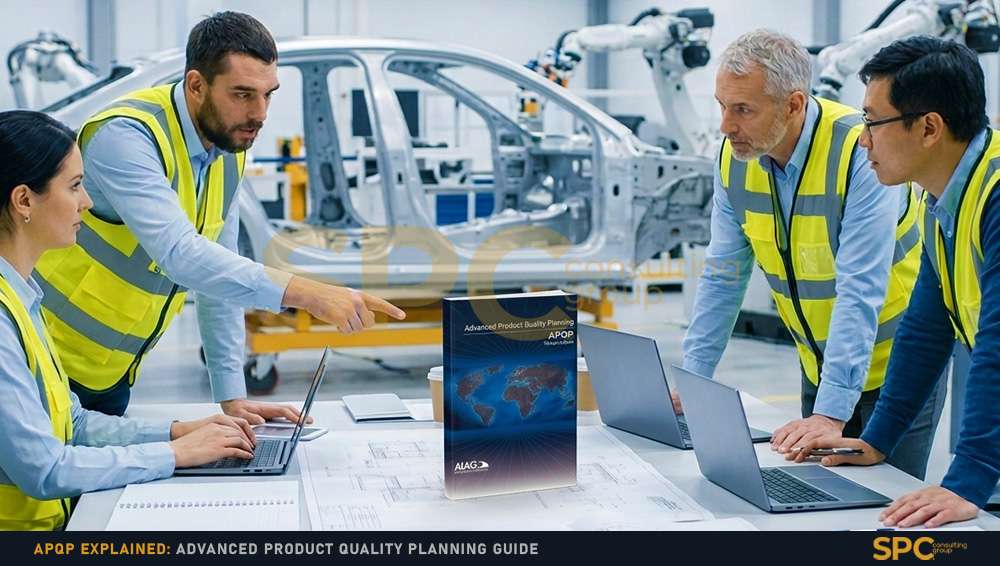
APQP Explained: Advanced Product Quality Planning Guide
Quick access
• What is APQP?
• Why is APQP important?
• What are the 5 phases of APQP?
• How does APQP work with other Core Tools?
• What is the difference between APQP and PPAP?
• Is APQP required for IATF 16949?
What is APQP?
APQP (Advanced Product Quality Planning) is a structured methodology used to ensure that products and manufacturing processes are developed effectively before production begins. APQP is one of the Automotive Core Tools and is widely used throughout the automotive industry to support quality planning, risk reduction, and successful product launches.
Along with PPAP, FMEA, SPC, MSA, and Control Plan, APQP forms part of the Core Tools framework commonly required by automotive manufacturers and suppliers. APQP is closely aligned with the requirements of IATF 16949 and is considered a best practice for managing product development and process readiness.

According to the Automotive Industry Action Group (AIAG), the purpose of APQP is to develop a product quality plan that supports the design and manufacture of products that consistently meet customer requirements.
Originally developed during the late 1980s through collaboration between Ford, General Motors, and Chrysler, APQP has become a standardized approach used by automotive OEMs, suppliers, and manufacturers worldwide.
Rather than focusing solely on product design, APQP provides a comprehensive framework that guides organizations from initial planning through production launch and continuous improvement.
Why is APQP important?
APQP helps organizations identify potential risks early in the product development process, reducing the likelihood of quality issues, delays, and costly corrective actions after launch.
The methodology promotes cross-functional collaboration between engineering, quality, manufacturing, purchasing, and suppliers, ensuring that customer requirements are understood and incorporated throughout the project.
Organizations use APQP to:
- Improve product quality and reliability.
- Reduce launch risks.
- Improve communication between customers and suppliers.
- Ensure manufacturing readiness.
- Support compliance with customer-specific requirements.
- Increase customer satisfaction.
Because APQP emphasizes prevention rather than correction, it has become one of the most effective planning methodologies in automotive manufacturing.
What are the 5 phases of APQP?
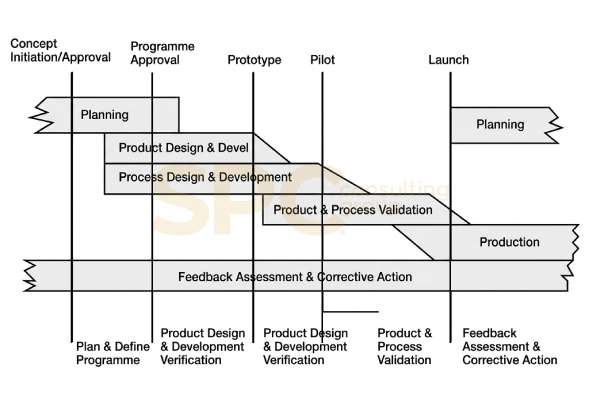
The APQP process is divided into five phases that guide product and process development from concept through production.
Phase 1: Planning and Program Definition
The first phase focuses on understanding customer expectations, product requirements, business objectives, and project scope.
Typical activities include:
- Voice of the Customer (VOC) analysis
- Market research
- Feasibility studies
- Preliminary risk assessment
- Definition of project goals
The objective is to establish a clear foundation for the entire project.
Phase 2: Product Design and Development
During this phase, product designs are created, reviewed, and validated.
Common deliverables include:
- Design records
- Design reviews
- DFMEA
- Design verification plans
- Prototype development
The goal is to ensure the product design meets customer expectations and performance requirements.
Phase 3: Process Design and Development
This phase focuses on creating a manufacturing process capable of producing the product consistently.
Typical activities include:
- Process Flow Diagrams
- PFMEA
- Control Plans
- Work instructions
- Tooling and equipment planning
- Measurement system planning
The process design must support quality, efficiency, and repeatability.
Phase 4: Product and Process Validation
Before production launch, organizations validate that both the product and manufacturing process can meet requirements under actual operating conditions.
Typical deliverables include:
- Production trial runs
- Process capability studies
- MSA studies
- Product testing
- PPAP submission
Successful completion of this phase provides confidence that production is ready to begin.
Phase 5: Feedback, Assessment, and Corrective Action
The final phase focuses on monitoring performance after launch and implementing improvements where necessary.
Activities often include:
- Customer feedback analysis
- Internal audits
- Process monitoring
- Corrective actions
- Continuous improvement initiatives
This phase helps sustain long-term product and process performance.
How does APQP work with other Core Tools?

One of the most common questions surrounding APQP is how it relates to the other Automotive Core Tools.
APQP serves as the overall project management and quality planning framework. The remaining Core Tools provide specific methods for managing risk, validation, measurement, and approval.
For example:
- FMEA helps identify and reduce risks.
- Control Plans define how critical characteristics will be monitored.
- MSA verifies measurement system capability.
- SPC monitors process performance.
- PPAP provides customer approval prior to production.
Together, these tools create a structured approach for preventing defects and ensuring product quality.
What is the difference between APQP and PPAP?
APQP and PPAP are often confused because they are closely connected.
APQP is the planning and development process used throughout product realization.
PPAP is the formal submission process used to demonstrate that APQP activities have been successfully completed and that the supplier is ready for production.
In simple terms:
- APQP focuses on planning and development.
- PPAP focuses on customer approval and production readiness.
Many of the documents created during APQP become part of the PPAP package.
Is APQP required for IATF 16949?
IATF 16949 does not specifically mandate the use of the AIAG APQP manual. However, many of the requirements contained within the standard align directly with APQP principles.
In practice, most automotive OEMs and Tier suppliers expect APQP methodologies to be used because they provide a proven framework for managing product and process development.
APQP is often considered an industry-standard approach for meeting customer requirements and supporting compliance with automotive quality management systems.
Looking to strengthen your team’s understanding of APQP and Automotive Core Tools?
Contact the experts at SPC Consulting Group to request customized APQP training or consulting services designed to help your organization improve product launches, reduce risk, and meet automotive customer requirements.
Frequently asked questions about APQP
What is the purpose of APQP?
The purpose of APQP is to ensure that products and manufacturing processes are developed in a structured manner that meets customer requirements and minimizes risk.
What are the 5 phases of APQP?
The five phases are Planning and Program Definition, Product Design and Development, Process Design and Development, Product and Process Validation, and Feedback, Assessment, and Corrective Action.
What is the difference between APQP and PPAP?
APQP is the planning process, while PPAP is the approval process used to demonstrate readiness for production.
Is APQP part of the Automotive Core Tools?
Yes. APQP is one of the Automotive Core Tools commonly used throughout the automotive industry.
Training & Resources




COPYRIGHT: It is prohibited to copy, reproduce, distribute, publish, transmit, broadcast, or in any way exploit any part of this material without proper attribution or prior written authorization from Servicios Profesionales de Alta Consultoría S.C. (SPC Consulting Group) or the respective rights holders.
You must cite this article by copying and pasting the following text:
APQP Explained: Advanced Product Quality Planning Guide
SPC Consulting Group
https://spc-us.com/apqp-advanced-product-quality-planning/
If you want to know more about APQP, get in touch with us today, or check out our online trainings courses accessible from any location.
You may also be interested in:
No Comments