

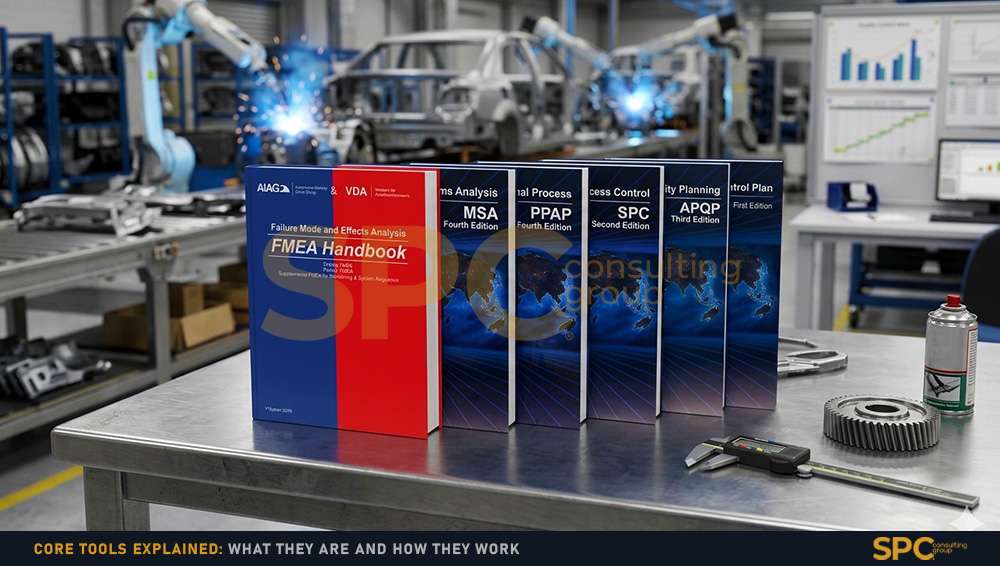
Core Tools Explained: What They Are and How They Work
Quick access
• What are the Core Tools?
• What are the 6 Core Tools?
• APQP: Advanced Product Quality Planning
• PPAP: Product Part Approval Process
• FMEA: Failure Mode and Effects Analysis
• SPC: Statistical Process Control
• MSA: Measurement Systems Analysis
• Control Plan
• How Core Tools work together
What are the Core Tools?
Core Tools are a standardized set of methodologies used in the automotive industry to ensure product quality, process consistency, and customer satisfaction. These tools were developed by the Automotive Industry Action Group (AIAG) in collaboration with major OEMs such as Ford Motor Company, General Motors, and Chrysler.
 They are a key requirement of the IATF 16949:2016 standard and are widely implemented across the U.S. automotive supply chain. Their primary objective is to create a structured, preventive, and data-driven approach to quality management.
Core Tools support organizations in:
- Developing robust products and processes
- Preventing defects rather than detecting them
- Standardizing quality practices across suppliers
- Improving communication between customers and suppliers
What are the 6 Core Tools?
Traditionally, Core Tools referred to five methodologies. However, current industry practice in the United States increasingly recognizes six Core Tools, incorporating the Control Plan as a core element.
The six Core Tools are:
- APQP (Advanced Product Quality Planning)
- PPAP (Product Part Approval Process)
- FMEA (Failure Mode and Effects Analysis)
- SPC (Statistical Process Control)
- MSA (Measurement Systems Analysis)
- Control Plan
The inclusion of the Control Plan has gained importance following the release of the Control Plan 1st Edition by the Automotive Industry Action Group (AIAG), reinforcing its role as a central document that connects risk analysis, process control, and validation activities.
APQP: Advanced Product Quality Planning
APQP is a structured methodology used to ensure that customer requirements are clearly defined and met throughout the product lifecycle—from concept development to production launch.
It plays a critical role in complex automotive programs by aligning cross-functional teams, including engineering, quality, manufacturing, and suppliers. APQP emphasizes early planning and risk prevention, which significantly reduces late-stage issues and costly changes.
The methodology is typically divided into five phases:
- Planning and program definition
- Product design and development
- Process design and development
- Product and process validation
- Feedback, assessment, and corrective action
APQP serves as the foundation of Core Tools, setting the direction and structure for all other activities.
PPAP: Product Part Approval Process
PPAP is the process used to demonstrate that a supplier can consistently meet all customer engineering and specification requirements before mass production begins.
It is a formal approval process required by OEMs and Tier 1 suppliers across the U.S. automotive industry. PPAP ensures that the manufacturing process is stable, capable, and fully understood.
The PPAP package includes documentation such as:

- Design records and specifications
- Process flow diagrams
- PFMEA
- Control Plan
- Measurement system studies (MSA)
- Initial sample inspection results
PPAP represents the final validation step after APQP activities have been completed.
FMEA: Failure Mode and Effects Analysis
FMEA is a structured risk analysis methodology used to identify potential failure modes in products or processes, evaluate their impact, and define actions to reduce risk.
It is widely used during both design and process development stages. By systematically analyzing potential failures, organizations can prioritize high-risk areas and implement preventive controls before issues occur.
Modern FMEA practices follow the AIAG & VDA harmonized approach, which introduces a structured 7-step methodology, Action Priority (AP), and stronger alignment with Control Plans.
FMEA is essential for building robust processes and minimizing the risk of defects reaching the customer.
SPC: Statistical Process Control
SPC is a data-driven approach used to monitor, control, and improve manufacturing processes through statistical analysis.
It focuses on identifying variation within processes and distinguishing between common cause variation and special cause variation. By using tools such as control charts, organizations can detect trends and take corrective action before defects occur.
SPC is critical for:
- Maintaining process stability
- Improving process capability
- Supporting continuous improvement initiatives
MSA: Measurement Systems Analysis
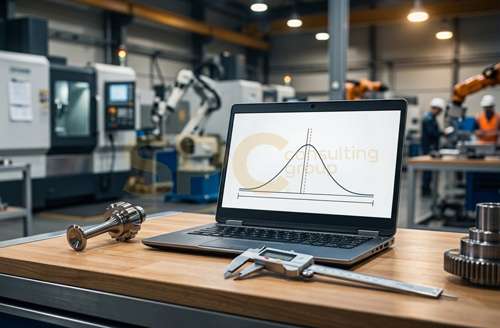 MSA evaluates the accuracy, precision, and reliability of measurement systems used in production and inspection.
Reliable data is essential for making correct decisions in quality management. If measurement systems are not capable, even the most advanced processes can produce misleading results.
MSA focuses on understanding variation in measurement systems, including equipment variation, operator variation, and environmental influences.
One of the most widely used MSA studies is Gage R&R, which quantifies repeatability and reproducibility within a measurement system.
Control Plan
The Control Plan is a critical document that defines how process characteristics will be monitored and controlled to ensure product quality.
It acts as a direct link between risk analysis and process execution by translating FMEA outputs into actionable controls on the shop floor.
A Control Plan typically includes:
- Process steps
- Key product and process characteristics
- Control methods and frequencies
- Reaction plans for out-of-control conditions
How Core Tools work together
Core Tools are designed to function as an integrated system rather than isolated methodologies:
- APQP defines the overall planning framework
- FMEA identifies and prioritizes risks
- Control Plan establishes process controls
- SPC monitors process performance
- MSA validates measurement reliability
- PPAP confirms readiness for production
This integration ensures that quality is built into both the product and the process, rather than inspected at the end.
Looking to successfully implement Core Tools and meet customer-specific requirements with confidence?
Contact SPC Consulting Group to request expert-led training or consulting services designed to improve your quality systems and operational performance.
Frequently asked questions
What are the Core Tools?
They are a set of standardized methodologies used to ensure quality, reduce risk, and meet customer requirements in the automotive industry.
Are there 5 or 6 Core Tools?
Traditionally there are 5, but many organizations now include the Control Plan as a sixth Core Tool due to its central role.
Are Core Tools required for IATF 16949?
Yes, Core Tools are essential for compliance with IATF 16949:2016 and are expected by OEM customers.
Who developed Core Tools?
They were developed by the Automotive Industry Action Group (AIAG) in collaboration with major automotive manufacturers.
Why are Core Tools important?
They help organizations prevent defects, improve process control, and ensure consistent product quality across the supply chain.
Training & Resources




COPYRIGHT: It is prohibited to copy, reproduce, distribute, publish, transmit, broadcast, or in any way exploit any part of this material without proper attribution or prior written authorization from Servicios Profesionales de Alta Consultoría S.C. (SPC Consulting Group) or the respective rights holders.
You must cite this article by copying and pasting the following text:
Core Tools Explained: What They Are and How They Work
SPC Consulting Group
https://spc-us.com/core-tools
If you want to know more about quality systems and pass your audit, get in touch with us today, or check out our online trainings courses accessible from any location.
You may also be interested in:
No Comments