

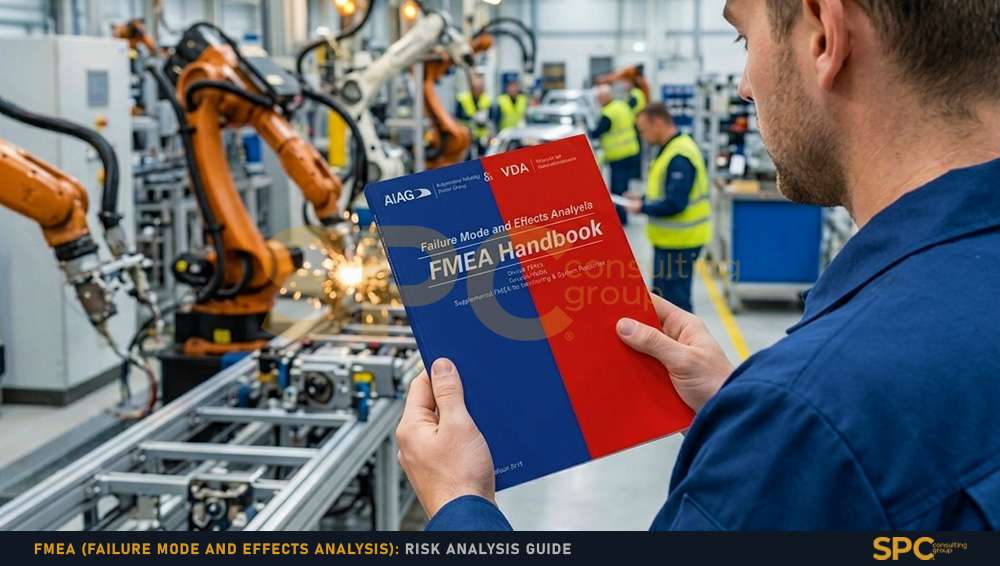
FMEA (Failure Mode and Effects Analysis): Risk Analysis Guide
Quick access
• What is FMEA?
• Why was the AIAG & VDA FMEA methodology developed?
• What are the 7 steps of AIAG & VDA FMEA?
• Understanding Severity, Occurrence, and Detection
• What is Action Priority in FMEA?
• Action Priority vs. Risk Priority Number (RPN)
• Common mistakes when performing FMEA
What is FMEA?
FMEA (Failure Mode and Effects Analysis) is a structured risk analysis methodology used during product and process development to identify potential failures before they occur. By evaluating failure modes, their effects, and their causes, organizations can prioritize improvement actions and reduce the likelihood of defects reaching the customer.
FMEA is developed during Advanced Product Quality Planning (APQP) and provides critical input for Control Plans, process controls, and product validation activities. It is one of the Automotive Core Tools and is widely used throughout the automotive industry to support compliance with IATF 16949 requirements.
Over the years, FMEA methodologies have evolved significantly. The most important recent development has been the creation of the AIAG & VDA FMEA approach, which provides a more structured and globally aligned framework for performing risk analysis.
Rather than treating FMEA as a paperwork exercise, the AIAG & VDA methodology focuses on understanding system structures, functions, failure chains, and risk prioritization in a more consistent manner.
Why was the AIAG & VDA FMEA methodology developed?
One of the most common questions among quality professionals is why the automotive industry introduced a new FMEA approach.
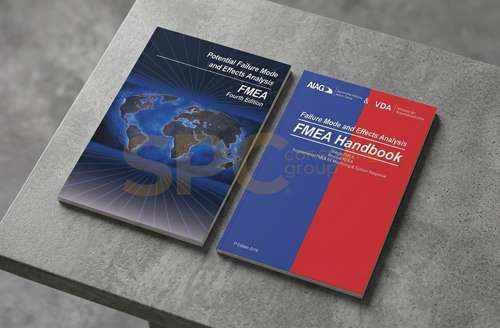
The AIAG & VDA FMEA handbook was developed through collaboration between the Automotive Industry Action Group (AIAG) and the German Automotive Industry Association (VDA). The goal was to harmonize different regional FMEA practices and establish a common methodology that could be used globally.
The updated approach introduced several improvements:
- Improved readability and organization.
- Stronger links between DFMEA and PFMEA.
- Better integration with APQP and Control Plans.
- Additional examples and practical applications.
- Enhanced Severity, Occurrence, and Detection evaluation criteria.
- More structured risk analysis techniques.
- Greater emphasis on management support and cross-functional teamwork.
- A shift away from relying solely on Risk Priority Number (RPN).
These improvements help organizations perform more effective risk assessments and make better decisions regarding improvement priorities.
What are the 7 steps of AIAG & VDA FMEA?
One of the defining features of the AIAG & VDA methodology is the structured 7-Step Approach.
1. Planning and Preparation
The first step establishes the scope, objectives, assumptions, and team responsibilities for the analysis.
2. Structure Analysis
This step defines the relationships between systems, subsystems, components, processes, and operations.
3. Function Analysis
Teams identify the intended functions and requirements associated with each element of the structure.
4. Failure Analysis
Potential failure modes, failure effects, and failure causes are identified and linked together.
5. Risk Analysis
Severity, Occurrence, and Detection ratings are evaluated to determine the level of risk associated with each failure chain.
6. Optimization
Actions are developed and implemented to reduce or eliminate risks.
7. Results Documentation
The final step captures decisions, actions, responsibilities, and lessons learned to support future projects.
This structured methodology improves consistency and helps teams identify risks more effectively than traditional approaches.
Understanding Severity, Occurrence, and Detection
Risk evaluation remains one of the most important aspects of FMEA.
Severity

Severity measures the seriousness of the effect that a failure may have on the customer, product performance, safety, or regulatory compliance.
Higher severity ratings indicate more serious consequences if a failure occurs.
Occurrence
Occurrence estimates the likelihood that a specific cause of failure will happen.
Organizations use historical data, process knowledge, and engineering judgment to determine occurrence ratings.
Detection
Detection evaluates the ability of current controls to identify or prevent failures before they reach the customer.
Strong detection controls generally result in lower detection ratings and reduced risk exposure.
Together, Severity, Occurrence, and Detection provide the foundation for evaluating and prioritizing risks.
What is Action Priority in FMEA?
One of the most significant changes introduced by the AIAG & VDA methodology is the use of Action Priority (AP).
Historically, many organizations relied heavily on Risk Priority Number calculations to prioritize improvement efforts. However, RPN values sometimes produced inconsistent priorities and could overlook high-severity risks.
Action Priority addresses this issue by focusing on the actual significance of the risk rather than relying solely on mathematical calculations.
Risks are categorized according to priority levels such as:
- High Priority
- Medium Priority
- Low Priority
This approach helps organizations focus resources on the most critical risks and encourages more meaningful risk-reduction activities.
Action Priority vs. Risk Priority Number (RPN)
Many professionals continue to ask whether RPN is still relevant.
Risk Priority Number is calculated by multiplying:
- Severity
- Occurrence
- Detection
While RPN remains a useful reference, the AIAG & VDA methodology does not recommend using RPN as the primary method for prioritizing actions.
A high-severity issue may require attention regardless of its calculated RPN value. For this reason, Action Priority is generally considered a more effective approach to decision-making.
Organizations that adopt the AIAG & VDA methodology often continue to review RPN values but rely primarily on Action Priority when determining improvement actions.
Common mistakes when performing FMEA
 Even experienced organizations can struggle to obtain maximum value from FMEA activities.
Common mistakes include:
- Treating FMEA as a compliance document rather than a risk-management tool.
- Completing FMEAs too late in the development process.
- Failing to involve cross-functional teams.
- Not linking PFMEA results to Control Plans.
- Focusing exclusively on RPN values.
- Neglecting updates after engineering or process changes.
An effective FMEA should be a living document that evolves as products and processes change.
Looking to strengthen your team’s understanding of AIAG & VDA FMEA, Action Priority, and advanced risk analysis techniques?
Contact the experts at SPC Consulting Group to request customized FMEA training or consulting services designed to help your organization improve risk prevention, product quality, and compliance with automotive industry requirements.
Frequently asked questions about FMEA
What is FMEA?
FMEA (Failure Mode and Effects Analysis) is a structured methodology used to identify potential failures, evaluate their impact, and implement actions that reduce risk before problems occur.
What do Severity, Occurrence, and Detection mean in FMEA?
Severity measures the impact of a failure, Occurrence estimates how likely the failure is to happen, and Detection evaluates the ability of existing controls to identify the failure before it reaches the customer.
What is Action Priority in FMEA?
Action Priority (AP) is a risk prioritization method introduced in the AIAG & VDA FMEA methodology. It helps organizations determine which failure modes require the most urgent improvement actions.
Is RPN still used in FMEA?
Risk Priority Number (RPN) may still be used as a reference, but the AIAG & VDA methodology recommends Action Priority as the primary method for prioritizing risk-reduction activities.
What are the 7 steps of AIAG & VDA FMEA?
The seven steps are Planning and Preparation, Structure Analysis, Function Analysis, Failure Analysis, Risk Analysis, Optimization, and Results Documentation.
Training & Resources




COPYRIGHT: It is prohibited to copy, reproduce, distribute, publish, transmit, broadcast, or in any way exploit any part of this material without proper attribution or prior written authorization from Servicios Profesionales de Alta Consultoría S.C. (SPC Consulting Group) or the respective rights holders.
You must cite this article by copying and pasting the following text:
FMEA (Failure Mode and Effects Analysis): Risk Analysis Guide
SPC Consulting Group
https://spc-us.com/fmea-failure-mode-and-effects-analysis/
If you want to know more about FMEA, get in touch with us today, or check out our online trainings courses accessible from any location.
You may also be interested in:
No Comments