

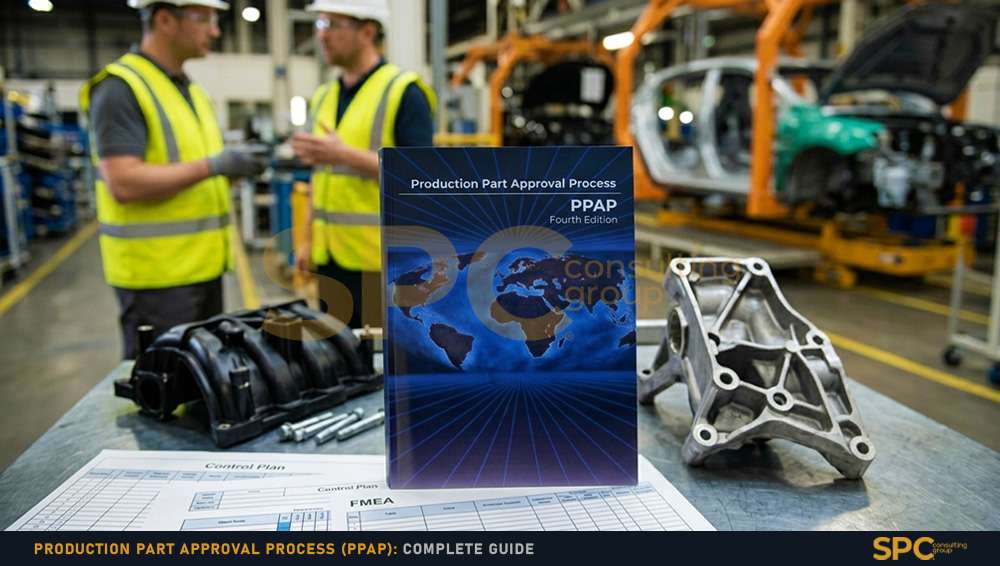
Production Part Approval Process (PPAP): Complete Guide
Quick access
• What is PPAP?
• Why is PPAP important?
• When is a PPAP required?
• What is the relationship between APQP and PPAP?
• What are the 18 elements of PPAP?
• What are the 5 PPAP levels?
• How does PPAP benefit suppliers and manufacturers?
What is PPAP?
PPAP, which stands for Production Part Approval Process, is one of the AIAG Core Tools used throughout the automotive supply chain to establish confidence that suppliers can consistently manufacture products that meet customer requirements.
PPAP is a requirement of the IATF 16949 quality management standard and is widely used by OEMs and suppliers to verify that a production process is capable of producing parts that conform to engineering specifications, quality requirements, and customer expectations.
Although many companies have customer-specific requirements, the AIAG PPAP manual provides a common framework that standardizes terminology, documentation, and submission requirements across the automotive industry.
The PPAP process is designed to demonstrate that a supplier has properly developed both the product and manufacturing process through effective use of APQP (Advanced Product Quality Planning), reducing the risk of defects, delays, and production disruptions.
Why is PPAP important?
PPAP helps ensure that products are ready for production before they reach the customer. Rather than relying solely on final inspections, PPAP focuses on validating the entire manufacturing process.
Organizations use PPAP to:
- Verify that customer requirements are fully understood.
- Confirm that manufacturing processes are stable and capable.
- Reduce the risk of quality issues during production.
- Improve communication between suppliers and customers.
- Support compliance with IATF 16949 requirements.
By identifying issues before production launch, PPAP helps organizations avoid costly defects, customer complaints, and production interruptions.
When is a PPAP required?
One of the most common questions asked by suppliers is when a PPAP submission is necessary.
PPAP may be required for:
- New product launches
- Engineering changes
- Material changes
- Manufacturing process changes
- Production transfers to a new facility
- New tooling or modified tooling
- Extended production shutdowns
- Customer-requested revalidation
Specific requirements vary depending on customer expectations and contractual agreements.
What is the relationship between APQP and PPAP?
APQP and PPAP are closely related but serve different purposes.
APQP is the planning methodology used throughout product and process development. It focuses on identifying risks, defining controls, and preparing for production.
PPAP is the formal validation process that demonstrates the results of APQP activities.
In simple terms:
- APQP builds confidence internally.
- PPAP provides evidence and confidence to the customer.
Many of the documents created during APQP become part of the PPAP package.
What are the 18 elements of PPAP?
The PPAP package is composed of multiple documents and records that demonstrate product and process readiness. Together, these elements provide objective evidence that customer requirements have been understood and that the manufacturing process is capable of consistently producing conforming parts.
Design and Engineering Documentation
1. Design Records
A copy of the engineering drawing or design record. If the customer owns the design, the drawing is typically provided through the purchase order process. If the supplier owns the design, the released supplier drawing is used.
2. Engineering Change Authorization
Documentation showing approved engineering changes and descriptions of modifications affecting the product.
3. Engineering Approval
Customer engineering approval of production parts when required.
Risk Analysis and Process Planning
4. DFMEA (Design Failure Mode and Effects Analysis)
A copy of the Design FMEA used to identify and reduce potential design risks.
5. Process Flow Diagram
A visual representation of the manufacturing process showing process steps, sequence, and material flow.
6. PFMEA (Process Failure Mode and Effects Analysis)
Analysis of potential process failures and actions used to mitigate manufacturing risks.
7. Control Plan
A document that defines how product and process characteristics will be monitored and controlled throughout production.
Testing and Measurement 

8. Measurement System Analysis (MSA)
Evidence that measurement systems are capable, including studies such as Gage R&R.
9. Dimensional Results
Measurement results demonstrating compliance with engineering specifications.
10. Records of Material / Performance Tests
Records of material verification and product performance testing.
11. Initial Process Studies
Statistical evidence demonstrating process capability and stability.
Documentation and Samples
12. Qualified Laboratory Documentation
Certification and accreditation records for laboratories performing tests.
13. Appearance Approval Report (AAR)
Required for products where appearance characteristics are critical.
14. Sample Production Parts
Representative parts from the production run used for approval.
15. Master Sample
An approved sample used as a reference standard.
16. Checking Aids
Documentation for fixtures, gauges, templates, and special inspection equipment.
Submission and Final Approval
17. Customer-Specific Requirements
Additional requirements defined by individual customers.
18. Part Submission Warrant (PSW)
The document that summarizes the entire PPAP submission and formally requests customer approval.
What are the 5 PPAP levels?
Another frequently searched topic is PPAP submission levels.
Level 1
- PSW only
Level 2
- PSW with limited supporting documentation
Level 3
- PSW with complete supporting documentation
Level 4
- PSW and documentation as defined by the customer
Level 5
- PSW with complete documentation available for review at the supplier’s facility
Level 3 is the most commonly requested submission level within the automotive industry.
How does PPAP benefit suppliers and manufacturers?
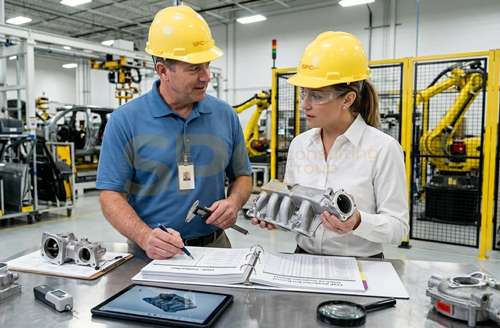
A successful PPAP process helps organizations:
- Launch products with greater confidence
- Improve customer satisfaction
- Reduce quality risks
- Demonstrate process capability
- Improve communication across the supply chain
- Support compliance with automotive quality standards
For automotive suppliers, PPAP is more than a documentation exercise, it is a structured approach to validating that products and processes are ready for production.
Looking to strengthen your team’s understanding of PPAP requirements, documentation, and submission processes?
Contact the experts at SPC Consulting Group to request customized PPAP training or consulting services designed to help your organization improve quality performance, meet customer requirements, and support IATF 16949 compliance.
Frequently asked questions about PPAP
Is PPAP required by IATF 16949?
PPAP is not a standalone clause within IATF 16949, but it is widely required by automotive customers and is closely linked to compliance with automotive quality management system requirements.
How many PPAP levels are there?
There are five PPAP submission levels, ranging from PSW-only submissions to full documentation reviews.
What is the purpose of PPAP?
The purpose of PPAP is to demonstrate that a supplier can consistently manufacture parts that meet customer requirements.
What is included in a PPAP package?
A PPAP package includes documentation such as FMEAs, Control Plans, Process Flow Diagrams, MSA studies, dimensional results, process capability studies, and the Part Submission Warrant (PSW).
Training & Resources




COPYRIGHT: It is prohibited to copy, reproduce, distribute, publish, transmit, broadcast, or in any way exploit any part of this material without proper attribution or prior written authorization from Servicios Profesionales de Alta Consultoría S.C. (SPC Consulting Group) or the respective rights holders.
You must cite this article by copying and pasting the following text:
Production Part Approval Process (PPAP): Complete Guide
SPC Consulting Group
https://spc-us.com/ppap-production-part-approval-process
If you want to know more about PPAP, get in touch with us today, or check out our online trainings courses accessible from any location.
You may also be interested in:
No Comments