

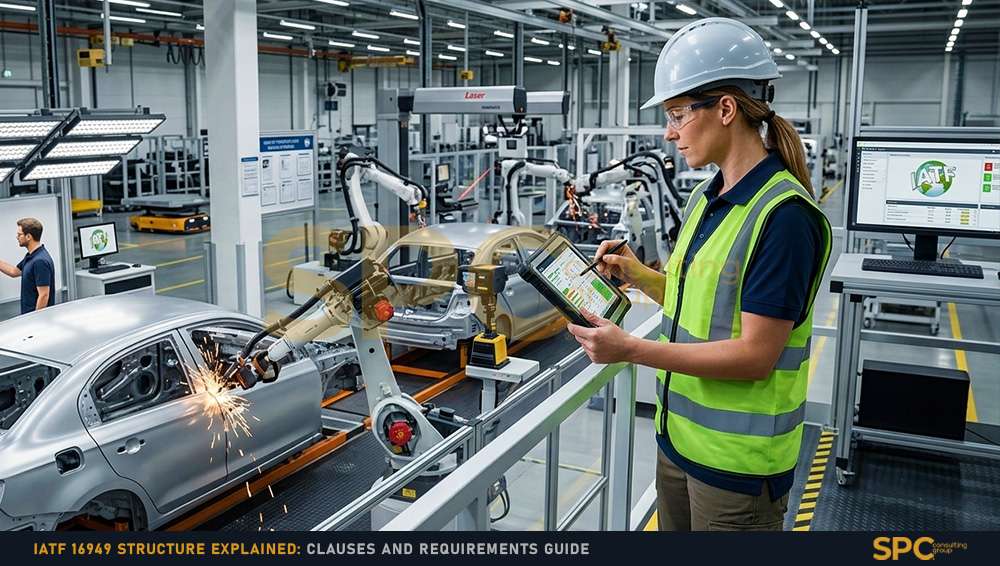
IATF 16949 Structure Explained: Clauses and Requirements Guide
Quick access
• What is the structure of IATF 16949?
• Why is the IATF 16949 structure important?
• What are the clauses of IATF 16949?
• How is IATF 16949 different from ISO 9001?
• What are the most important requirements in IATF 16949?
What is the structure of IATF 16949?
IATF 16949 is the internationally recognized quality management system standard for the automotive industry. Developed by the International Automotive Task Force (IATF), it establishes requirements for organizations involved in automotive production, service parts, and related manufacturing activities.
Published in 2016, IATF 16949 aligns with the High-Level Structure (HLS) introduced in ISO 9001:2015. This common framework allows organizations to integrate quality management systems with other standards more efficiently.
One important aspect of IATF 16949 is that it does not replace ISO 9001. Instead, it supplements ISO 9001 with additional automotive-specific requirements. As a result, organizations must understand both standards to achieve and maintain certification.
The structure of IATF 16949 follows ten main clauses.
Why is the IATF 16949 structure important?
Understanding the structure of IATF 16949 helps organizations: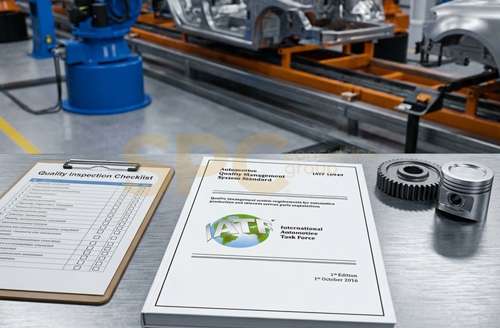
- Implement a compliant quality management system.
- Prepare for certification audits.
- Understand customer-specific requirements.
- Align quality objectives with business strategy.
- Improve process performance and customer satisfaction.
- Support continual improvement initiatives.
Because automotive customers expect suppliers to demonstrate robust quality management practices, familiarity with the structure of IATF 16949 is essential.
What are the clauses of IATF 16949?
Clause 1: Scope
This clause defines the applicability of the standard and identifies the organizations and activities covered by IATF 16949.
The standard applies to organizations that manufacture automotive products, service parts, or assemblies specified by automotive customers.
Clause 2: Normative References
This section references ISO 9001:2015 as the foundational quality management standard on which IATF 16949 is based.
Organizations cannot fully understand IATF 16949 without also referencing ISO 9001.
Clause 3: Terms and Definitions
Clause 3 provides definitions for terminology used throughout the standard.
Understanding these terms ensures consistent interpretation of requirements across organizations, auditors, and customers.
Clause 4: Context of the Organization
Organizations must identify internal and external factors that affect their ability to achieve intended results.
This includes:
- Interested parties
- Customer expectations
- Business environment
- Organizational risks and opportunities
The goal is to ensure that the quality management system supports the organization’s strategic direction.
Clause 5: Leadership
Leadership plays a central role in IATF 16949.
Top management must:
- Demonstrate commitment to the quality management system.
- Establish quality policies.
- Promote customer focus.
- Support process ownership and accountability.
Strong leadership involvement is considered essential for successful implementation.
Clause 6: Planning
Planning focuses on risk-based thinking and quality objectives.
Organizations are required to:
- Address risks and opportunities.
- Define measurable quality objectives.
- Plan changes effectively.
- Support preventive actions through systematic planning.
This clause helps organizations proactively manage potential issues before they affect customers.
Clause 7: Support
The support clause covers the resources needed to operate the quality management system.
Key topics include:
- Competence and training
- Awareness
- Communication
- Infrastructure
- Monitoring and measurement resources
- Documented information
Organizations must ensure that employees have the necessary knowledge, skills, and resources to perform their responsibilities effectively.
Clause 8: Operation
Clause 8 contains many of the automotive-specific requirements and is often considered the most extensive section of the standard.
It addresses:
- Product realization
- Customer requirements
- Design and development
- Supplier management
- Production control
- Contingency planning
- Change management
Many requirements associated with APQP, PPAP, FMEA, SPC, MSA, and Control Plans are closely connected to this clause.
Clause 9: Performance Evaluation
Organizations must monitor, measure, analyze, and evaluate the effectiveness of their quality management system.
Activities include:
- Internal audits
- Management reviews
- Customer satisfaction monitoring
- Process performance evaluation
- Quality performance metrics
This clause ensures that decisions are based on objective evidence rather than assumptions.
Clause 10: Improvement
The final clause focuses on continual improvement.
Organizations are expected to:
- Identify opportunities for improvement.
- Correct nonconformities.
- Implement corrective actions.
- Improve process effectiveness.
- Enhance customer satisfaction.
Continual improvement remains one of the core principles of IATF 16949.
How is IATF 16949 different from ISO 9001?
One of the most common questions in the automotive industry is how IATF 16949 differs from ISO 9001.
While ISO 9001 provides the foundation for quality management systems across all industries, IATF 16949 introduces additional automotive-specific requirements.
Examples include:
- Product safety requirements
- Customer-specific requirements
- Manufacturing process controls
- Supplier development expectations
- Warranty management
- Risk analysis methodologies
- Automotive Core Tools integration
These additions make IATF 16949 significantly more rigorous than ISO 9001 alone.
What are the most important requirements in IATF 16949?
Although every clause is important, organizations often focus on:
- Risk-based thinking
- Customer satisfaction
- Internal auditing
- Supplier management
- Process effectiveness
- Product safety
- Problem-solving methodologies
- Continual improvement
Successful implementation requires these elements to work together within a process-based management system.
Looking to strengthen your organization’s understanding of IATF 16949 requirements and automotive quality management systems?
Contact the experts at SPC Consulting Group to request customized IATF 16949 training or consulting services designed to help your team improve compliance, audit readiness, and overall quality performance.
Frequently asked questions about IATF 16949 Structure
What is the structure of IATF 16949?
The structure consists of ten clauses, including Scope, Normative References, Terms and Definitions, Context of the Organization, Leadership, Planning, Support, Operation, Performance Evaluation, and Improvement.
Is IATF 16949 based on ISO 9001?
Yes. IATF 16949 is built upon ISO 9001:2015 and includes additional automotive-specific requirements.
What is the most important clause in IATF 16949?
All clauses are important, but many organizations consider Clause 8 (Operation) particularly critical because it contains numerous automotive-specific requirements related to production and product realization.
Is IATF 16949 mandatory for automotive suppliers?
While not legally required, many automotive OEMs and Tier suppliers require certification as a condition of doing business.
Training & Resources




COPYRIGHT: It is prohibited to copy, reproduce, distribute, publish, transmit, broadcast, or in any way exploit any part of this material without proper attribution or prior written authorization from Servicios Profesionales de Alta Consultoría S.C. (SPC Consulting Group) or the respective rights holders.
You must cite this article by copying and pasting the following text:
IATF 16949 Structure Explained: Clauses and Requirements Guide
SPC Consulting Group
https://spc-us.com/structure-iatf-16949
If you want to know more about IATF 16949, get in touch with us today, or check out our online trainings courses accessible from any location.
You may also be interested in:
No Comments